Slopulism
The Outcome of Left Populism

I identify left populism with the political theory articulated by Ernesto Laclau and Chantal Mouffe in Hegemony and Socialist Strategy, first published in 1985.1 In its original incarnation, left populism was a response to three things:
In so far as the working class still existed, it had become substantially less interested in socialism.
In so far as interest in socialism still existed, it seemed to be coming from the new social movements, rather than the working class.
By 1985, the repeated electoral victories of Ronald Reagan and Margaret Thatcher and the “austerity turn” of François Mitterand had clearly illustrated the political limits of the labor movement, even as a mere vehicle for electing democratic socialists or social democrats.
In the 1970s, the first two phenomena were observable in seed form. But the major defeat suffered by George McGovern in 1972 put off, for more than a decade, the idea that a viable political movement could be built around an alliance of educated people with marginalized groups. The door could only be reopened once other approaches had repeatedly failed.
In the hands of Laclau and Mouffe, the aim of left populism is still socialism. But the experience of the late 1970s and early 1980s has taught that socialism cannot be achieved principally by appealing to the material interests of the working class. There is, therefore, a need for a kind of discourse management that can construct the sort of alliance that will not arise through the social use of democratic reason. This discourse management involves the use of floating signifiers, abstractions with unspecified content. By leaving the content of the signifier unspecified, each citizen who encounters the signifier can fill it with whatever they like. Values, such as “emancipation” and “equity” can be floating signifiers. So too can individuals—the leader of a left populist movement must be many things to many people. The messaging of the left populist leader is produced by educated elites, who use social science techniques to study the voters and grasp what moves them. In this way, left populism creates a role for the “scholar-activist” whose research is politically engaged, and whose political engagement is scientific.
The idea that management is necessary to produce socialism does not originate with Laclau and Mouffe. It’s in Habermas’ Legitimation Crisis, which came out in 1973. But for Habermas, the function of the management is to produce a felt contradiction between the promise of democracy and the reality of post-war Keynesian economic managerialism. That felt contradiction then leads to demands for substantive democratization, which are meant to ultimately overcome the managerialism through which they were produced. By contrast, for Laclau and Mouffe, socialism must be directly produced through the management of the discussion. The form socialism takes must therefore be compatible with the managerial method by which it is to be pursued. Left populism is therefore much more overtly nationalist than Habermasian constitutional patriotism, because left populism operates on the premise that the nation-state is a permanent feature rather than something that is to be eventually subsumed into a post-national project. It is for this reason that left populism is sometimes described pejoratively as a kind of Stalinism—it has the overtly national horizons consistent with its managerial form.
Now, as it happened, the people who were the most successful in using the left populist strategy were not the socialists for whom it was designed. Instead, the centrists of the third-way had the most success with it. They had the money to pay the social scientists, and they had no qualms about influencing the workers from above. Rather than speak in terms of emancipation or equity, they frequently spoke in terms of hope, change, or the future. Leaders such as Tony Blair, Bill Clinton, Barack Obama, and François Hollande all used these techniques far more effectively than the socialists for whom they were designed. And, as these figures used these techniques to persuade voters to allow them to pursue neoliberal structural reforms, socialists who attempted to use the same techniques became associated with the same substantive politics.
After 2008, socialists attempted to reclaim left populism from the neoliberal center. But this was made difficult in part by the very techniques of left populism. When leaders position themselves as floating signifiers, it becomes difficult to adjudicate what particular politicians really believe. And, because the left populist techniques are used to bring people who are not interested in socialism into socialist movements, it becomes easy to turn significant parts of a left populist base against a socialist candidate who offends against the pet causes of particular marginalized constituencies. So, in the 2010s, socialists struggled to take control of the left populist apparatus, and even in so far as they did gain control, their hold was precarious and easily challenged by new iterations of the liberal centrism they hoped to overcome.
By 2020, the socialist attempts had not only failed, they had resulted in purges. The socialists within the left populist parties were driven out. By 2024, Kamala Harris and Keir Starmer were both deploying the techniques of left populism on behalf of liberal centrism once again. Consider, for instance, Harris’ extensive deployment of freedom as a floating signifier:

However, by this point, large parts of the public have become inured to these techniques, because they have been deployed so many times without producing much in the way of tangible benefits. Political leaders who use populist techniques struggle to achieve high favorability ratings or to maintain them for any great length of time. The honeymoons grow ever shorter, as increasingly cynical voters turn against those they take to be deceivers with ever greater speed.
So, in the UK, Keir Starmer now has an incredibly poor approval rating. But this has not created an opportunity for socialists in Britain. There are no longer any significant number of socialists in the Labour Party, so there is no possibility of capturing the party. The demise of Starmer therefore compels the British left to create alternative party forms. These alternatives all take up left populism, but place it in different roles.
The Workers Party of Britain
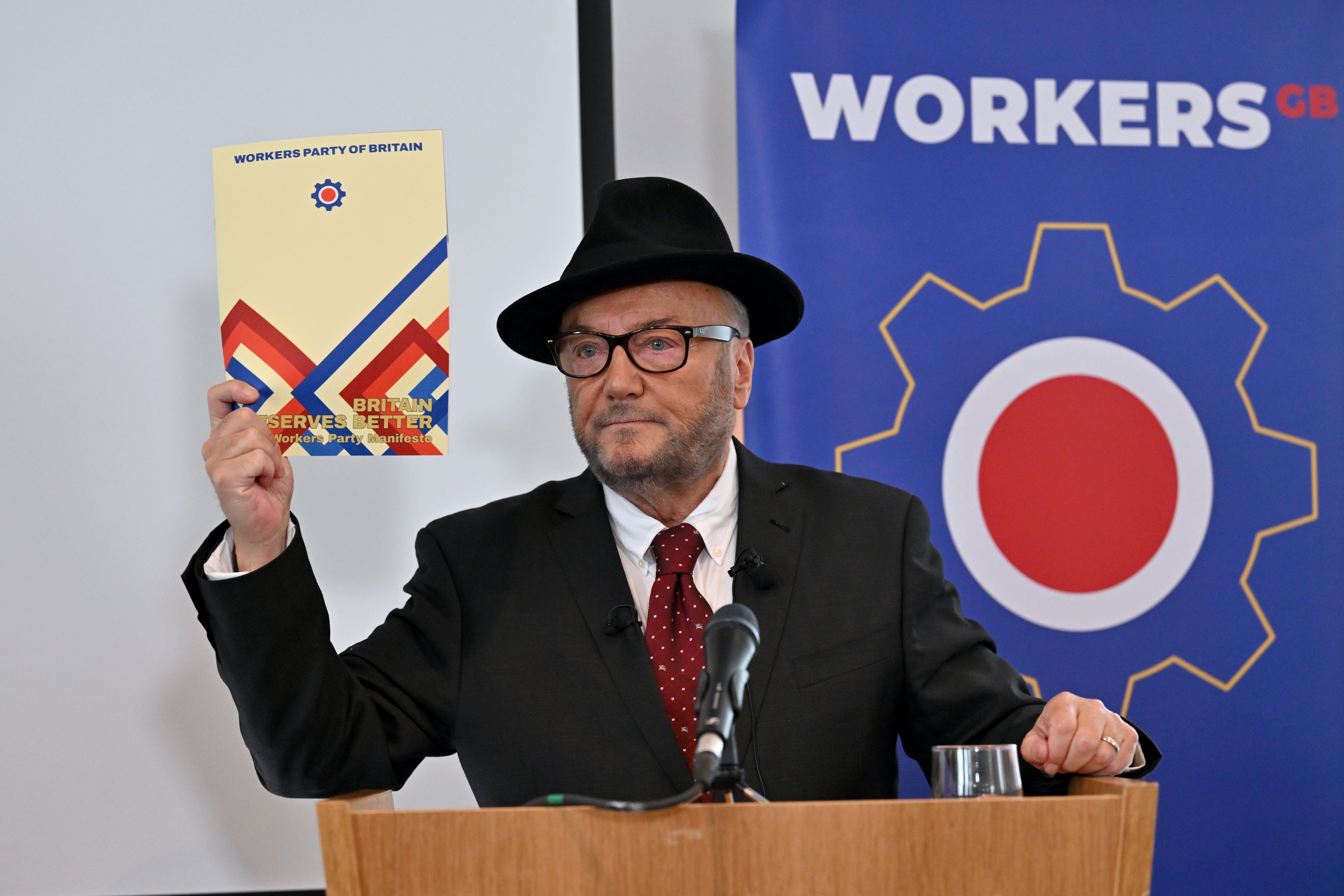
George Galloway’s party attempts to remain committed to the working class at the level of language, while strategically deploying left populism in a bid to win over marginalized demographics, particularly Muslim immigrants. However, at this point, many British workers have objections to immigration from the Islamic world. And, because Galloway eschews conventional identity politics, there are many other interest groups for whom he’s persona non grata. And, because the Workers Party remains a populist endeavour, it can only go as far as its leader’s reputation permits. Galloway is not particularly good at being a floating signifier, because he has too many idiosyncratic positions that he takes too consistently to wave away. So, a populism based around Galloway cannot grow to a competitive size.
Your Party
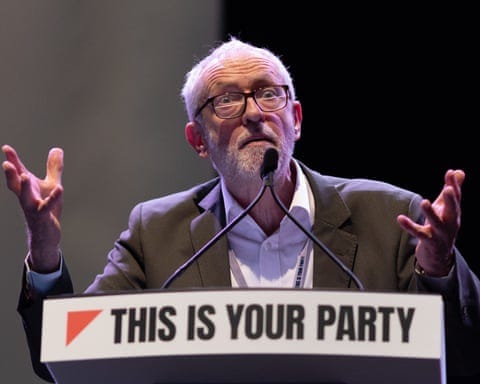
Jeremy Corbyn and Zarah Sultana attempted to make a party that could be led democratically by its members. The problem is that young members have been politically educated by decades of left populism to follow leaders who operate as floating signifiers. These members have not been taught the political virtues necessary to take prudent political decisions. When leftists constituted by left populism get an opportunity to deliberate about what to do, they ultimately decide to adopt left populist rhetorical modes. This results in a kind of left populism that is guided not by social science, but by the underdeveloped opinions of the confused offspring of managerialism. Consider, for instance, the party’s name—the name “Your Party” has no substantive content and is clearly a floating signifier. The members of Your Party demanded that Your Party be populist, and so, despite the attempt to adopt a bottom-up procedural structure, Your Party quickly collapsed into disputes over whether Corbyn or Sultana ought to be regarded as its symbolic figurehead. Because Your Party was, from the start, deeply confused about what it is on a quite fundamental level, it immediately descended into farce and now polls at zero. A similar fate awaits anyone who tries to pretend populism did not happen, who imagines that young people can simply hop into the saddle when they have never been taught how to ride.
The Green Party
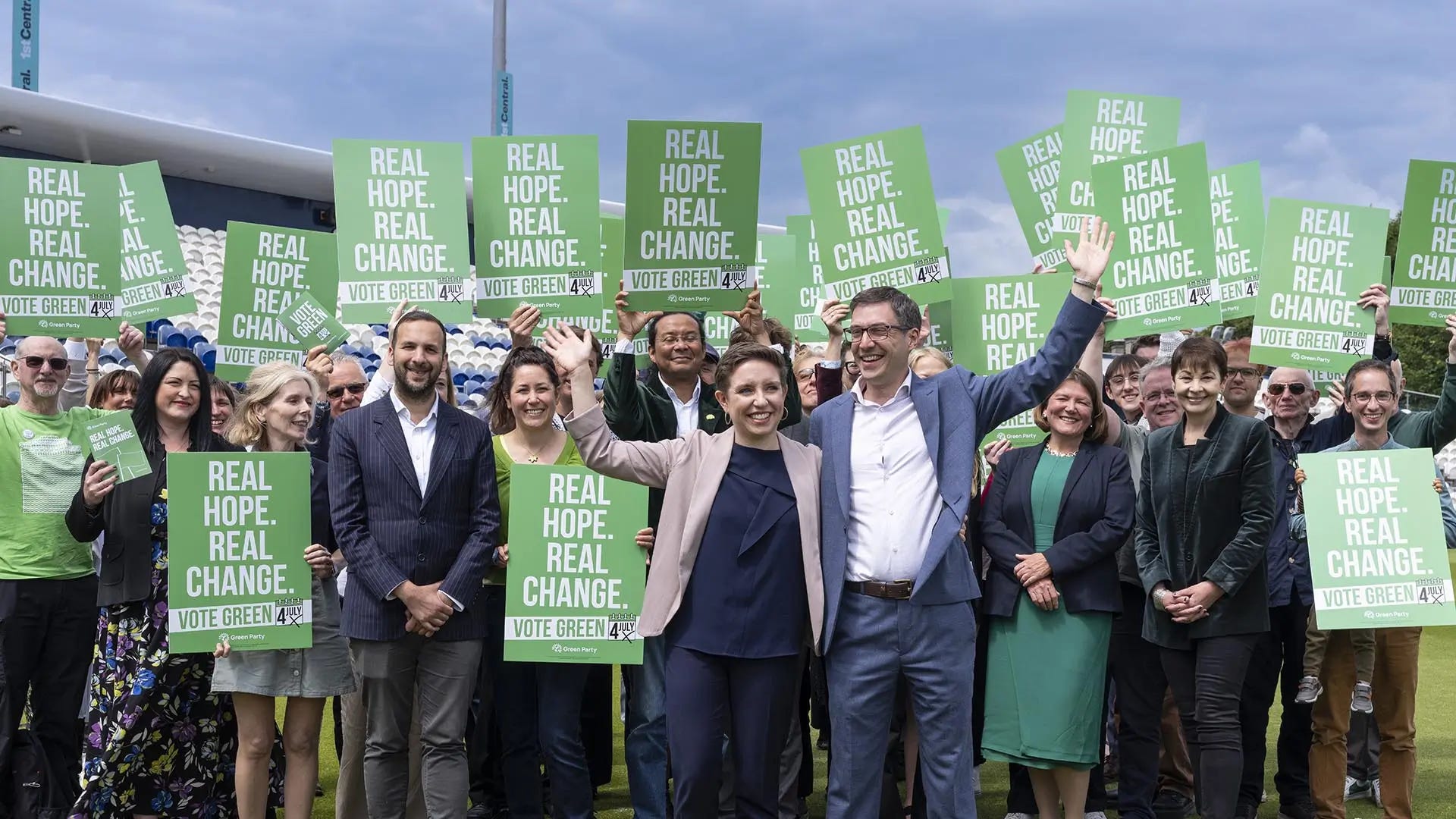
Unlike the Workers Party and Your Party, the Green Party does not make a pretense of being socialist or belonging to the workers or to the people. Its campaign materials use floating signifiers that directly reference those of Barack Obama—“hope” and “change”. Its leader, Zack Polanski, is a former supporter of the Liberal Democrats who backed tuition fee hikes and accused Jeremy Corbyn of tolerating antisemitism in the Labour Party in the late 2010s. Its policies are vaguely enumerated and, in so far as they have been specified, make no plan to emancipate Britain from the bond markets that have scuppered experiments of every kind over the past fifty years. When Corbyn was leading the Labour Party, there were at least talks of monetary experiments—such as People’s Quantitative Easing—that were marginally plausible in the post-2008 era, when interest rates were stuck near zero and government borrowing costs were at historic lows. Today, the politics around spending are shaped by supply chain disruptions (COVID, Ukraine, Iran) that have resulted in substantially higher rates, greatly reducing the scope for national experiments. Yet, because left populism is grounded on the hope that meaningful national experimentation remains possible, this new political environment is never acknowledged. Instead, we get even less rigor with regard to the policy discussion than was customary during the 2010s. The result is a kind of populism that can, in practice, only be in the service of the sort of policies that would have been attractive to the Liberal Democrats in the era of Nick Clegg.
This neoleft populism is not merely post-Marxist, it is now post-socialist, too.2 It’s a kind of slopulism, and it is only attractive to very young people who have been systematically denied a proper political education. Its function, in practice, will be to split the Labour Party vote share, facilitating the further Americanization of the UK under the next right-wing government. Those who imagine it can have any other result can only be pitied at this stage.
Discussed extensively on Political Theory 101:
See my piece introducing the concept of "neoleftism”: